
A Sourdough Spin
...on my Multigrain Protein Bread, plus sourdough starter tips, new SALT PIG episodes, and more

So that you know I’m not sending this off from a vacuum: I, too, have been spending the past few weeks increasingly alarmed and appalled by current events (Luisa’s SOS resonates deeply). I don’t know what the right thing to do is (donate, advocate for what you believe in, spend your money wisely, be a good neighbor), but part of it must be protecting the capacity to sustain some kind of focus. These platforms profit with their vise on our attention. So I’m doubling down on credible news twice a day, taking it in intentionally rather than passively, regularly tuning to historians for context and perspective, and just trying my best to engage with my people directly rather than through an algorithm. —LV
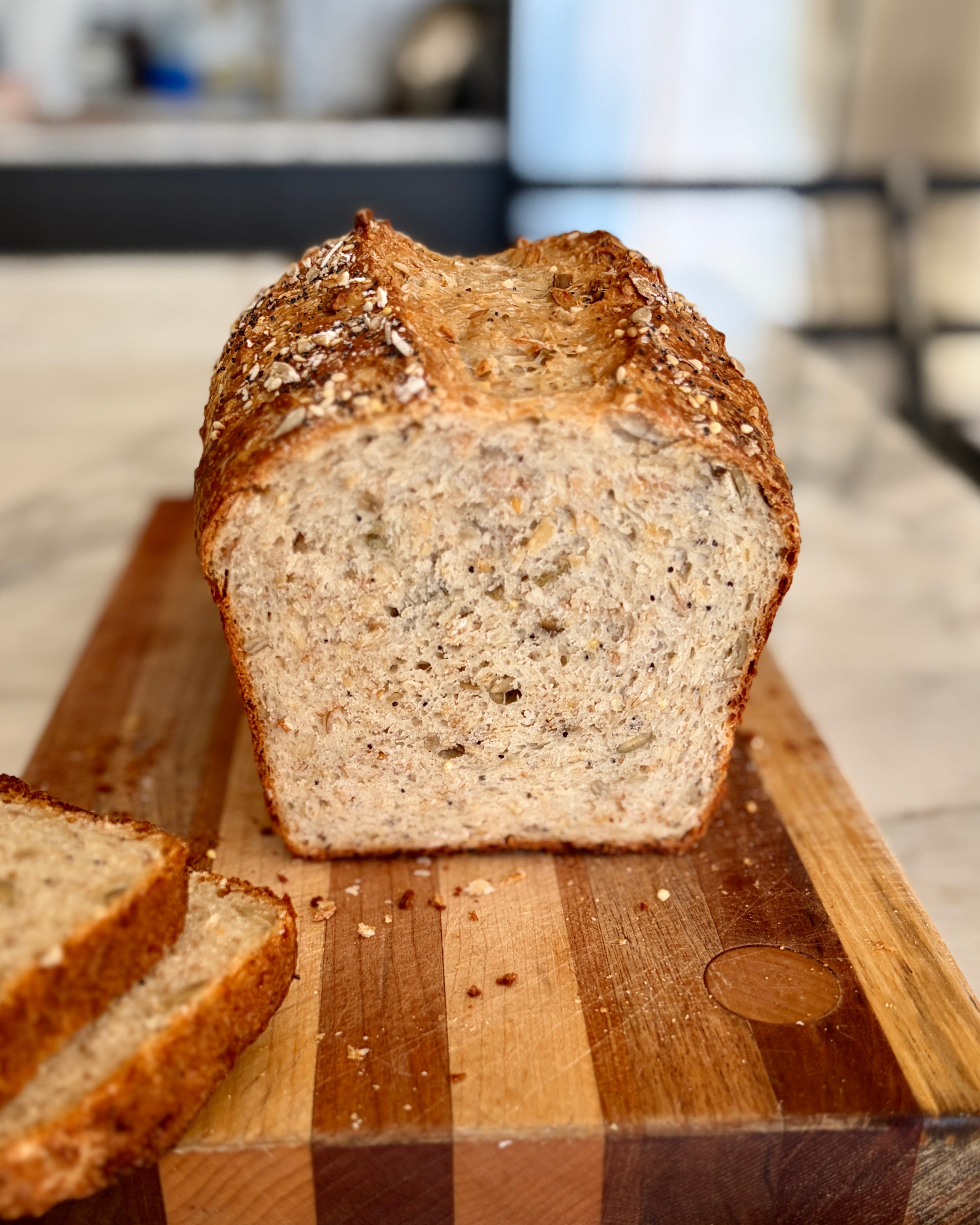
Ever since I finalized my multigrain protein bread recipe, I’ve been tinkering with a sourdough variation on it. I knew that a little tangy flavor would be nice, and I’ve been curious to give it the more muscled structure and extended freshness that happens with slow, natural fermentation.
If you haven’t made the original recipe, it’s helpful to know that even though it bakes off into a soft and fluffy bread that has a nice, crunchy crust, the dough is a rather dense, tacky, and even wet-seeming one. Not a smooth, taught ball, or a loose, buoyant, shimmery dough, which is what I typically associate with home-baked sourdough. This feature of the protein bread has complicated things, at least from a sourdough perspective.

But after many dense, poorly risen attempts, I finally realized that what it needs is a little bit of help: a small amount of commercial yeast. The yeast gives the dough a little insurance policy and as well as a kickstart, pumping extra carbon dioxide into the dough to lighten the loaf and move its natural fermentation along.
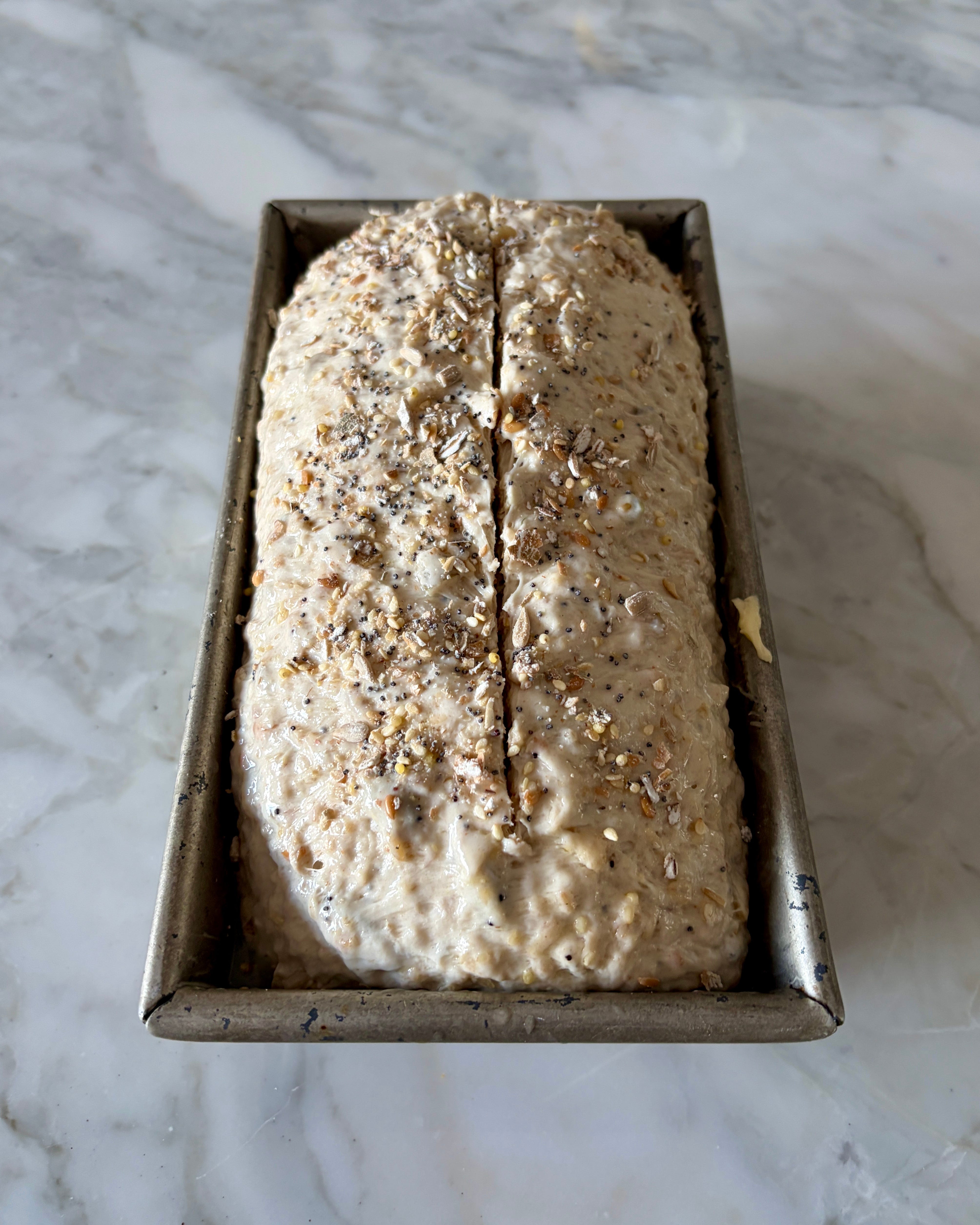
It’s not a 100% naturally leavened loaf this way, and instead what bakers call a “hybrid” style of fermentation. I encountered this method while working on my bread machine book, because it can be useful when making sourdough bread behave (aka, rise more quickly) in a bread machine cycle. But bread bakers who are much smarter than me can explain the science and logic of how it works and when it’s best to use the method.
This sourdough spin isn’t very much more complicated than the original recipe. You will need ripe sourdough leaven, meaning that a spoonful of your sourdough starter has been fed with water and flour, and allowed to bubble up and bloom. And the dough needs to follow its own schedule during the bulk rise and proofing — you cannot make it start to finish in a bread machine. But otherwise there are no special techniques and nothing different from the original recipe.
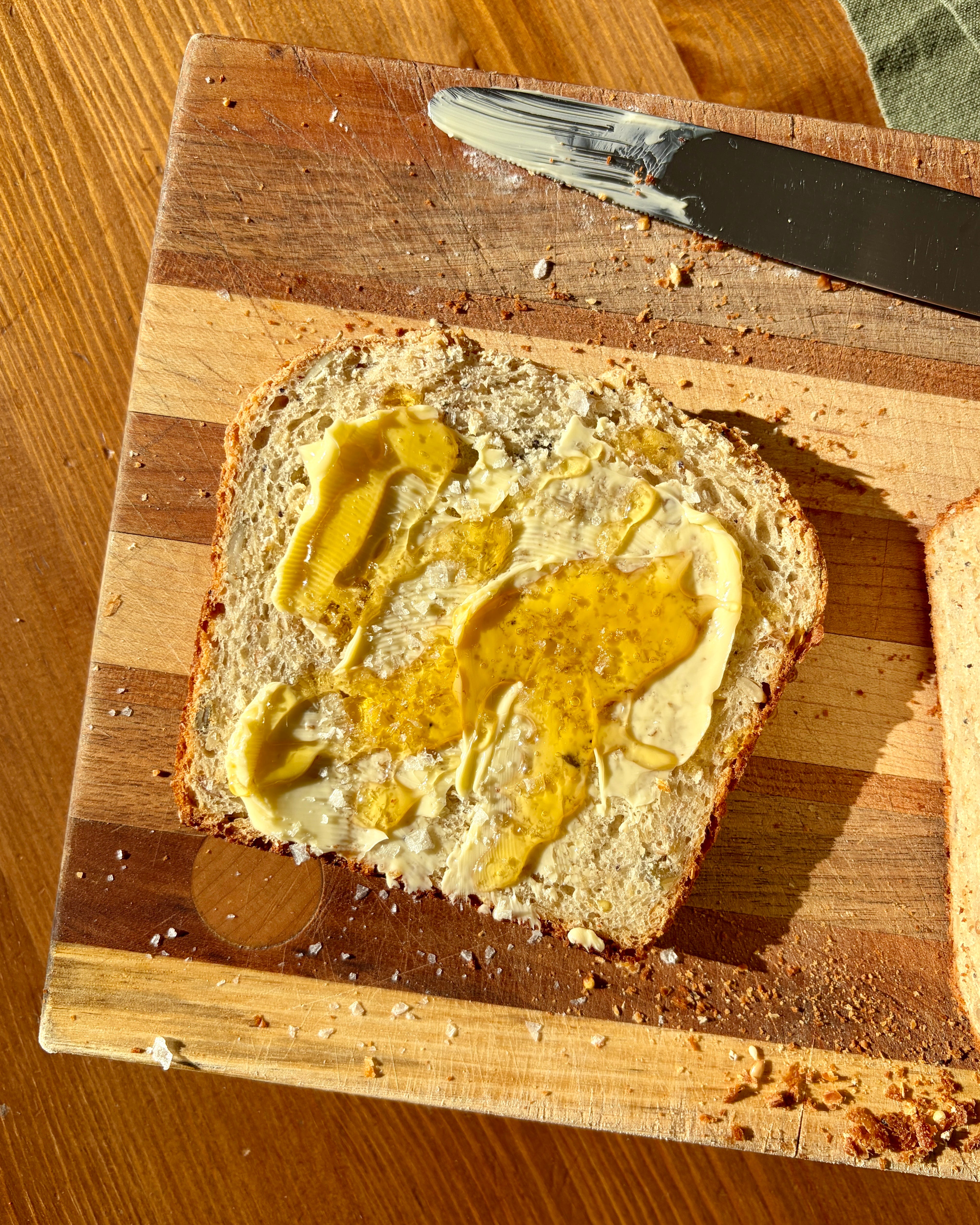
I just love this bread with honey, butter, and salt. I also love it for sandwiches (especially grilled cheese), and with bowls of chili or any robust soup. It really is a versatile, broadly appealing loaf. Even fresh out of the oven and still a little warm (though for legal reasons it must be said that it slices best when completely cool), it is exactly the treat I want when the temperature outside isn’t going above freezing anytime soon.
If You’re New to Sourdough Starter…
I truly believe that making and maintaining a sourdough starter is easy, but it’s like anything that requires routine — you need a runway to figure out and establish your rhythm with it. If you can acquire a bit of someone else’s starter, before baking with it just put a spoonful of it in a clean jar, add equal parts (by weight, about 75g) of water and flour, and let it bubble up over the course of several hours.
I broke down the process of creating one from scratch in The Bread Machine Book, and you can download those instructions below. But there is a wealth of information about this topic online. Alexandra Stafford is a trusted resource, and she has an easy step-by-step guide here as well.

Three Episodes into SALT PIG
…and the fourth goes live on Tuesday morning. We’ve discussed food waste being in conflict with exacting recipes, how we love our dishwashers and have absurdly strong opinions about loading them, and everything we can think of about spinach, which is a lot…. what will be next? Subscribe to our newsletter below to be notified first of new episodes, and to get occasional dispatches from Elinor Hutton and me. Or find them wherever you listen to podcasts (Spotify, Apple, etc). And please rate and review if you’re so inclined!

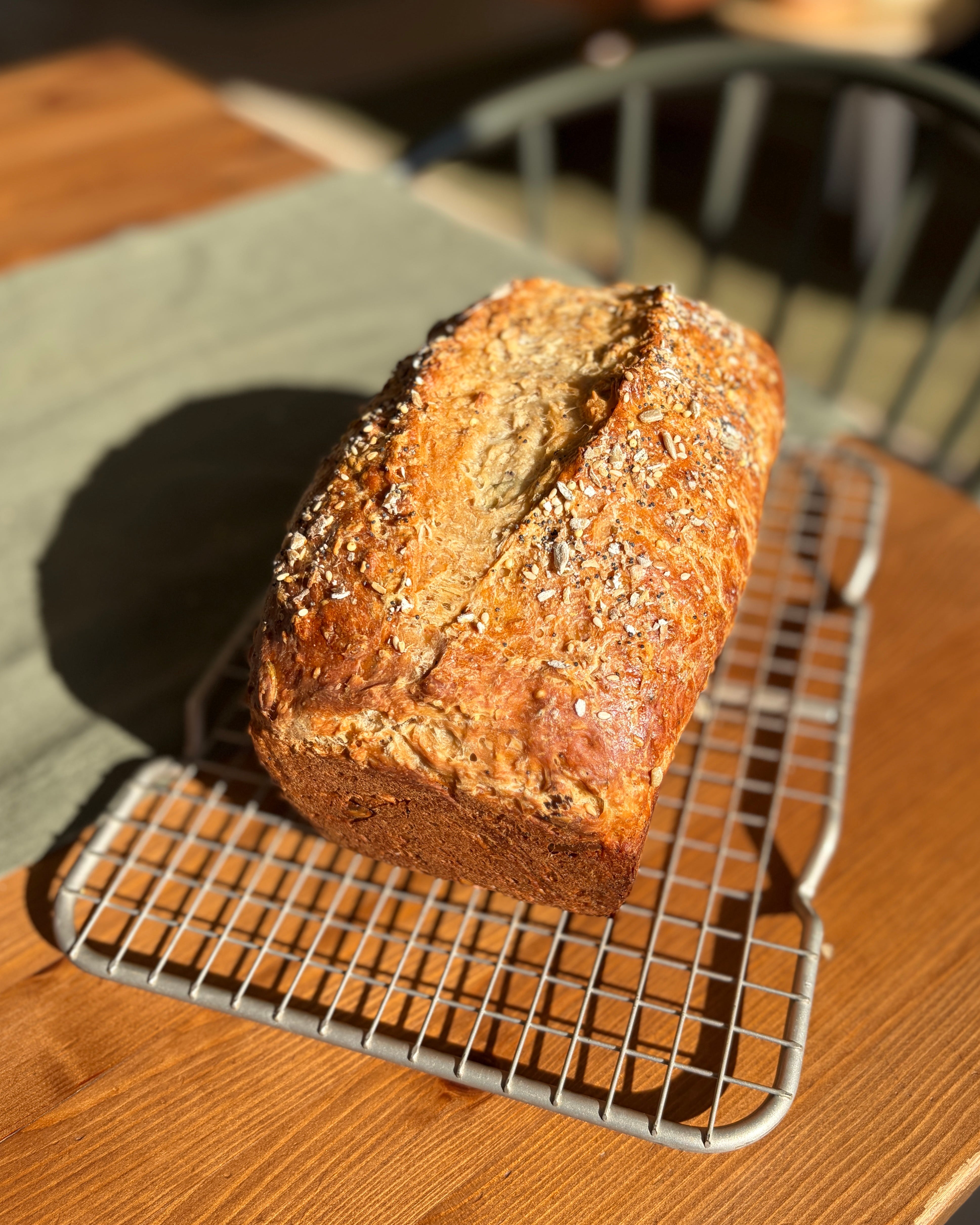
Sourdough Multigrain Protein Bread
Be sure to reference my original recipe on King Arthur Baking, especially if you’re interested in the non-sourdough version. There are lots of helpful comments there from people who’ve baked it, too, with tips on variations and workarounds.
Ripe Sourdough Leaven: The 125g of “ripe sourdough leaven” below means you will have recently fed your sourdough starter with fresh flour and water, and allowed it to ripen and bloom. To be precise, for this recipe, I take 15 grams of my sourdough starter, combine it with 75 grams water and 75 grams flour (usually about 15g whole wheat or rye, plus the remaining 60g all-purpose flour, because the whole wheat or rye are very helpful with keeping the sourdough starter active), and allow 4 to 8 hours for it to ripen until it’s three to four times its original size, very bubbly, smells slightly sweet and sour, and has a loose texture. Then I measure out 125 grams of it for the recipes, and reserve the discard for my next baking. Note that the sourdough leaven here is a 100% hydration one, meaning that it is fed with equal parts (by weight) of water and flour.
If you do a lot of bread baking and want an easy, ready-made medley of seeds and cracked grains to toss into your doughs, I love the Harvest Grains Blend that King Arthur sells, and I use it often in this bread. But it’s also easy to cobble through the pantry and make your own. Just use seeds and grains that are small — flax seeds, chia seeds, poppy seeds, sesame seeds, raw sunflower seeds, cracked grains, coarse polenta even steel cut oats all work.
This makes a big, 2-pound loaf. It works great in a standard 9- by 5-inch loaf pan as well as a taller pullman pan (bake it uncovered). Or make two smaller loaves by dividing it between two 8- by 4-inch loaf pans.
Rising times will vary significantly based on your own kitchen conditions, as well as by the vitality of your sourdough starter. Use your judgment rather than the timer. You can speed up the rising time a bit by doubling the instant yeast to ½ teaspoon, which makes the loaf manageable to bake off over the course of 1 day, but it will have less pronounced sour flavors. You can also proof it (step 6) on the countertop, which will take 2 to 5 hours at room temperature, but again, you won’t have pronounced sourdough flavor.
As always, a digital scale makes things tidier and better! That’s why I put them first in the recipe below.
Storage: Loosely wrap leftover bread in a plastic bag and keep at room temperature for up to 4 days; freeze the sliced bread in an airtight bag or container for up to 2 months.
Makes 1 (2-pound) loaf or 2 smaller loaves
120g (3 large) egg whites or 100g (2 large) whole eggs, plus additional lukewarm water
125g ripe sourdough leaven (see second bullet above)
227g (1 cup) cottage cheese
42g (2 tablespoons) honey
10g (1¾ teaspoons) kosher salt
360g (3 cups) bread flour
113g (1¼ cups) old-fashioned rolled oats
28g (2 tablespoons) unsalted butter, at room temperature, plus more for greasing
¼ teaspoon instant yeast
75g (¼ cup) mixed seeds (see above) or King Arthur Harvest Grains Blend, plus more for sprinkling
40g (¼ cup) raw pumpkin seeds
Lightly beaten egg white, for brushing
First, measure the egg whites or whole eggs in a tall measuring glass, and add additional water to reach 180 grams total liquid, or ¾ cup volume.
To make the dough in a bread machine: Combine the egg and water mixture, leaven, cottage cheese, honey, salt, flour, oats, butter, and yeast, in that order, and program your machine on its DOUGH setting, to mix and knead the dough. If or when the alert for additions sounds off, add the mixed seeds and pumpkin seeds (if your machine doesn’t have this feature, you can add them along with the other ingredients, or in the last few minutes of the cycle). Once the dough has finished kneading, halt the program — it will be too warm inside and the bread will rise too quickly inside it.
Or, to make the dough in a stand mixer: Combine the egg and water mixture, leaven, cottage cheese, honey, salt, flour, oats, butter, and yeast, in that order, in the bowl of a stand mixer, and mix using the dough hook mix on medium speed until the dough starts to pull from the sides of the bowl, 5 to 7 minutes. Add the mixed seeds and pumpkin seeds and continue mixing until they’re evenly incorporated.For the bulk rise: Transfer the dough to a greased bowl or other container, and let it rise until doubled in size in a dark and cool spot, roughly 3 to 6 hours, depending on the temperature of your kitchen.
Use softened butter to grease a 9- by 5-inch standard loaf pan, a 9- by 4-inch pullman loaf pan, or two smaller 8- by 4-inch loaf pans.
Shape the dough: Gently scrape the dough onto a clean work surface. I have not needed to use any extra flour for shaping, but if you find it too sticky to handle dust your hands and the dough very lightly lightly, and use a dough scraper to maneuver things. Being careful not to deflate the dough, gently stretch it into a rectangle(s) and then roll into log(s) to fit in your greased loaf pan(s).
Proof the dough: Cover the pan(s) with plastic wrap and transfer to the refrigerator to proof for 12 to 36 hours, until doubled in size. Allow to warm at room temperature for an hour before baking.
Score and Bake: Preheat the oven to 400ºF. Brush the proofed dough with egg white, and sprinkle the top(s) with a few pinches of mixed grains, then score with a sharp knife, making a 1/4-inch cut down the length of the top.
Transfer to the oven and bake for 10 minutes, then reduce the temperature to 350ºF and continue baking for 30 to 40 minutes more, until nicely browned and sounds hollow when tapped. Tip onto a cooling rack and cool completely before slicing.
Thanks Lukas! I've been loving this loaf and considering, 1: adding steel cut oats, and 2: using sourdough starter. You've answered both for me! I've been happy using 3 whole eggs for about 150 g then adding water to reach the prescribed 180 g for more protein and moisture in the loaf. We're also loving the pumpkin seeds for protein and texture. This is a really tasty, flexible recipe. Many thanks for your great work.
Just made this loaf and it is super delicious....a bit more dense than regular wholegrain sourdough but with a great chewy bite. A sure repeat recipe!
I followed the recipe, almost exactly. The cottage cheese measurement at 1 cup seemed a lot less than the 227 grams indicated - so I used closer to 217 grams.
One question - do I need to make sure that all the initial ingredients (eggs, cottage cheese) are room temp before beginning? Also - I have a question about the bulk fermentation - you say place in a cool dark spot. Why is this as opposed to the usual warm environment for 1st rise? I placed in my living room - dark and prob 63 degrees and left for 7 hours to double in volume. Then put in loaf pan, in refrig and baked the next morning. I covered the pan for the initial 10 minutes then uncovered @350 for 40 minutes, and inserted a thermometer to determine when it was done - interior at close to 190 degrees.
Thanks for sharing this recipe!