
Multigrain Protein Bread
And a quick dispatch from the other side of the planet


Hello and happy 2026 from Australia, which is where I’ve been for the past two weeks. From December until now has been nonstop, and when I’m asked about resolutions I give a blank stare. Yet being down here, I’m inspired by some of what I’ve eaten, which will influence the next year’s cooking.
More peas. Breakfast last week, at one of the casual cafés that Sydney and Melbourne are famous for, was smashed sweet peas on toast, topped with poached eggs. It was absolutely perfect: nutritious, delicious, seemingly quite simple. I cook with peas often enough that there are always some in the freezer, but I rarely make them the focal point of the meal. Expect more peas in 2026.
Sweet chili sauce. Vincent recently introduced me to an Australian custom of serving roasted potato wedges with sour cream and Thai-style sweet chili sauce on the side. The two condiments are scooped into the same little ramekin without being stirred together, and I was so skeptical. But it really works, being sweet, spicy, tangy, and cooling all at once. Then the other day I had a basic egg-and-cheese breakfast sandwich, and I was struggling to the sweet and spicy element. Of course it ended up being sweet chili sauce. This is a condiment I’m eager to experiment with in 2026, and I’m thinking it might be fun to make my own.
Quick, whole-grain breads. I was flipping through a Bill Granger cookbook (he was a famed Australian chef, widely credited with popularizing the fresh and vibrant café food culture down here) and came across a recipe for a seedy rye loaf. It contains no yeast or leavener, and requires no soaking, kneading, or really any effort beyond just stirring and packing the dough into a tin. I haven’t tried it yet, but I’m eager to, and to dive deeper into the world of these types of easy, nutritionally dense breads.
I’m also excited to share that I’ve just begun work on a new cookbook. It will have a nutrition focus similar to what I’ve been doing here in this newsletter for the past few years, which means that there will be explicit attention to protein and fiber. But to me it is about food for the “middle ages” (I’m in my forties) and fuel for active living. Stay tuned for much more over the next 12 months as I develop the project.

Finally, I want to highlight a recipe that I recently wrote for King Arthur Baking, for multigrain protein bread. While my Plush Protein Bread uses tofu for its protein boost, this one has a more robust cast of ingredients, including cottage cheese, eggs (whites or whole), rolled oats, and a liberal dose of nubby seeds, which fleck each slice with flavor and texture.
You can make it either in a bread machine or use a stand mixer. In both instances, it’s pretty simple — just add all the ingredients to your mixing vessel to mix and knead the dough. In the bread machine, it will proceed to rise, be shaped, proof, and bake. If you use a stand mixer, you’ll need to shape the loaf by hand, move it to a loaf pan, and bake it in your oven.
Here you can see the side-by-side differences of the two methods:
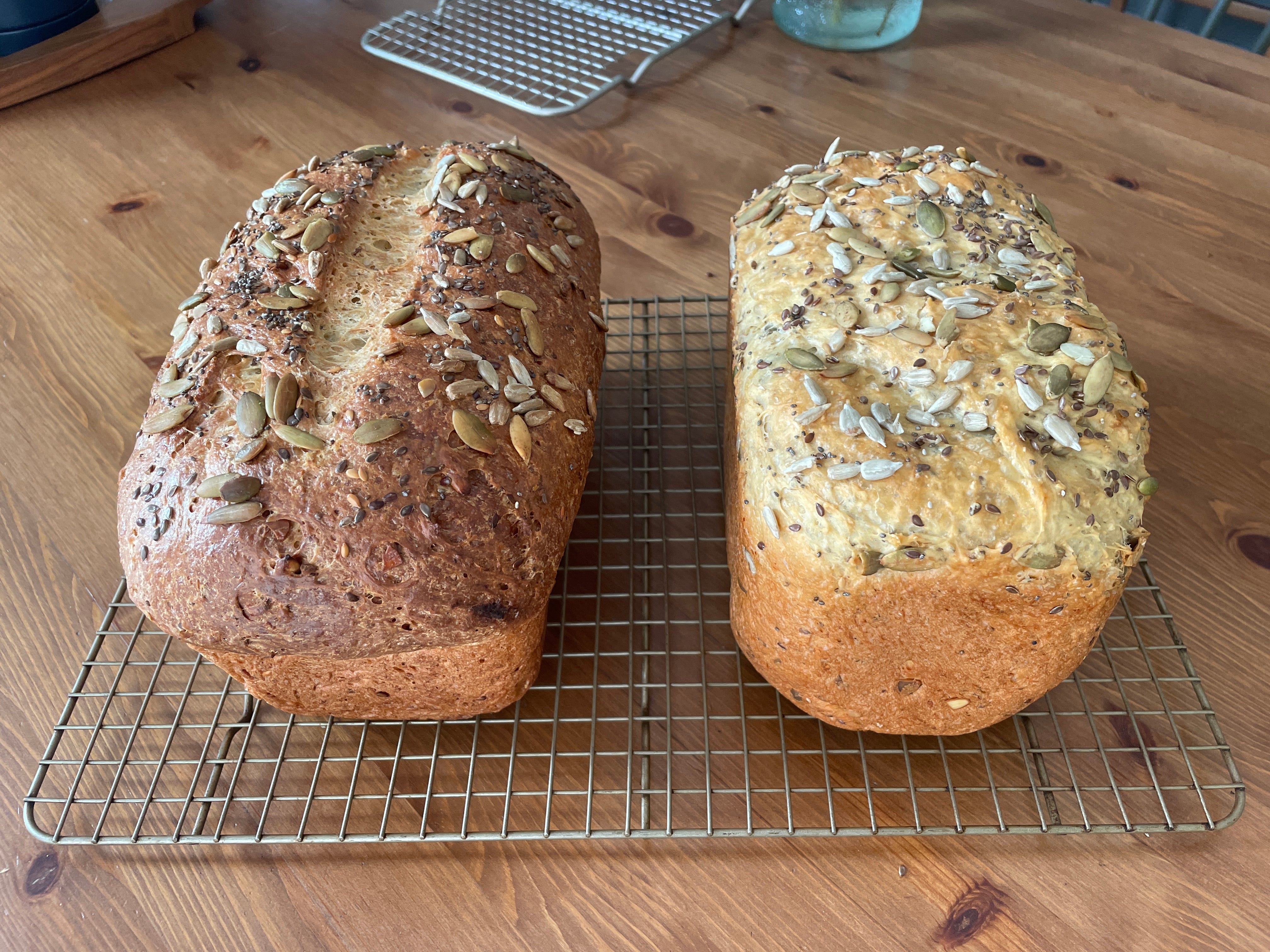
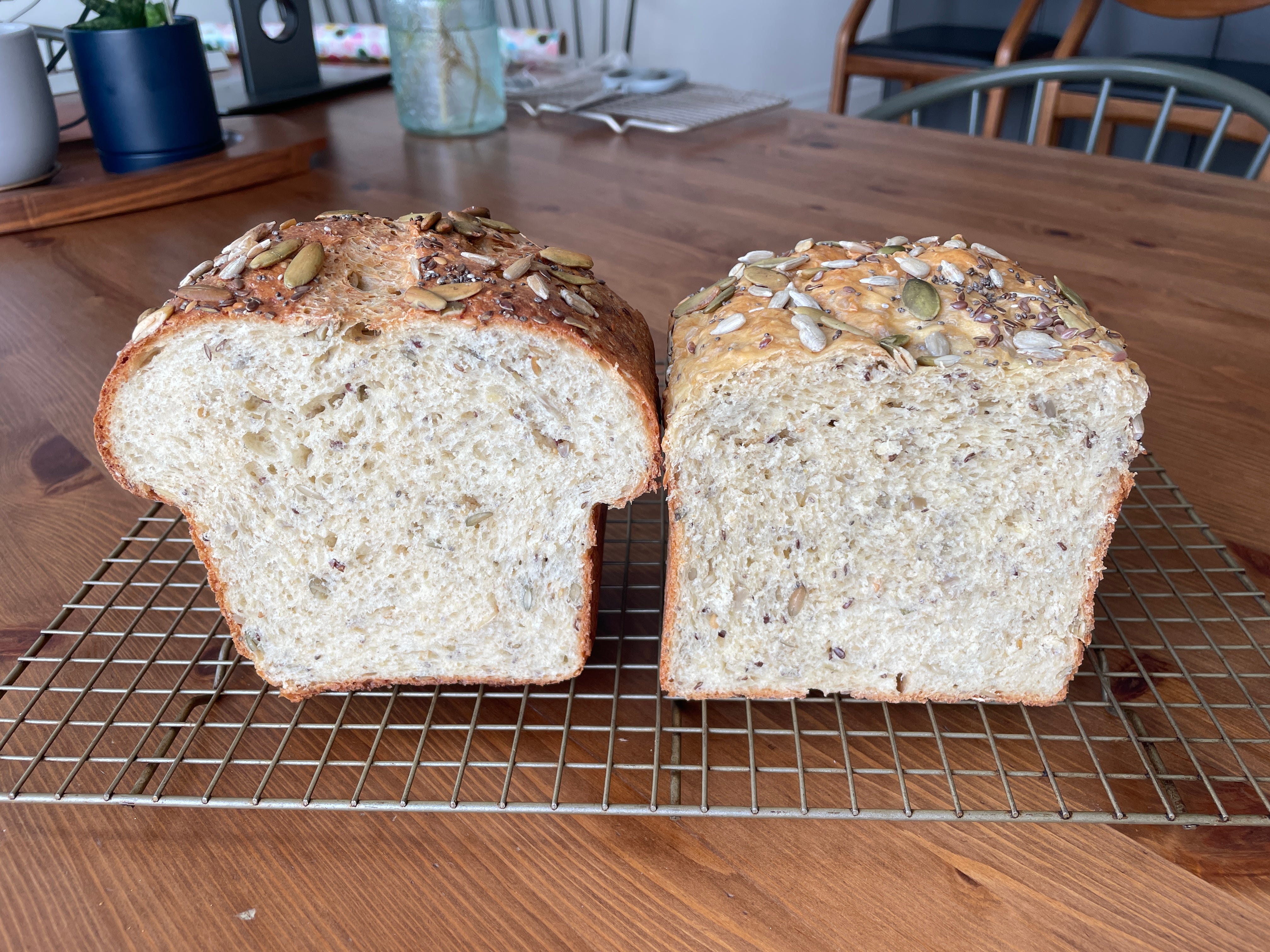
Obvious points of difference…
The crust, which is much darker and “crustier” after baking in the oven. Even with a top-of-the-line bread machine such as the Zojirushi Vitruoso Plus (which is what I use), the oven has stronger, more thorough and well-circulated heat than a bread machine. This is why I love the “Dough” setting on the bread machine. I use it to mix, knead, and handle the bulk rise (or first proofing) of the dough; from there I shape the dough by hand and bake it in my oven.
And then the shape. The Zojirushi has the advantage of a traditional loaf-shape pan rather than a tall, narrow one that characterizes so much bread machine bread. But even so, I’d argue that it still looks like it came from a bread machine, without the appealing rounded top, cavities in the bottom, and opportunity to score and decorate the surface, too.
That said, both have a fluffy crumb, and both are delicious. I love this bread for toast, sandwiches, and snacking, and I find it to be a truly all-purpose bread, with a pleasantly neutral flavor and broadly appealing texture. It’s an added bonus that each slice boasts about 11 grams of protein.
You’ll need to click over to the King Arthur Baking site for the recipe, but I have just two extra notes.
This is a 2-pound loaf, so if your bread machine has different size settings, be sure to select that one.
King Arthur Baking’s Harvest Grains Blend is a handy pre-made blend of seeds for all manner of baking, and it features in this recipe. But you can very easily riff your own blend of seeds instead, based on what you’ve got on hand. I’ve made this recipe using 3 tablespoons (26g) raw hulled sunflower seeds, 2 tablespoons (26g) flax seeds, 1 teaspoon chia seeds, and 1 teaspoon poppy seeds. Sesame seeds, hemp seeds, and pumpkin seeds would all work well, too. You need 7 to 8 tablespoons total. You can also just leave them out.
If you like this recipe, be sure to check out The Bread Machine Book, as well as my Plush Tofu Protein Loaf:
My Plush Protein Bread, My New Cookbook

Happy weekend, everyone! Today I’m very excited to share a new project of mine, one that’s a little different from what I’ve done so far.
Thanks for reading, and happy new year! —Lukas
Lukas—I thought of you this morning when I was making savory oats, now an early January ritual thanks to you. I want to bake more bread this year. And I am super excited about your book project! Congrats!
This bread is SO good (snuck a few slices in the test kitchen).